

Education
(Projects)
Educational Challenges in Developing Countries

In developing countries, shortages of teachers and learning materials make it difficult to provide high-quality education. The disparity between rural and urban areas is particularly pronounced, and we must ensure that educational opportunities reach children who are otherwise expected to work to support their families. However, the educational environment itself presents severe challenges that actively hinder children’s motivation to learn.
- The Limits of Individualized Instruction and Growing Polarization:
Classrooms are often severely overcrowded, a situation exacerbated by chronic teacher shortages and frequent, unexpected absences. Because tailoring instruction to individual comprehension levels is extremely difficult, a stark polarization is advancing within traditional mass instruction: students who are “left behind without understanding” and those who feel “unchallenged and disengaged.” - An Overwhelming Lack of Practice Opportunities to Build Fundamentals:
High-quality textbooks and workbooks are not sufficiently widespread. In subjects like mathematics, where sequentially building a strong foundation is essential, schools lack the practical means to provide the crucial repetitive practice (exercise volume) necessary to solidify these core skills.
Examples of IT-based Solutions
- Spread of e-learning apps that can be used offline
- Remote classes and learning management systems using mobile devices
- Personalized learning support tools that adapt to each student’s level of comprehension
Our Achievements
Development and Maintenance of a Math Application (JICA Project)
Solutions through App Development: “Personalized Optimization” and “Mechanisms for Continuity”
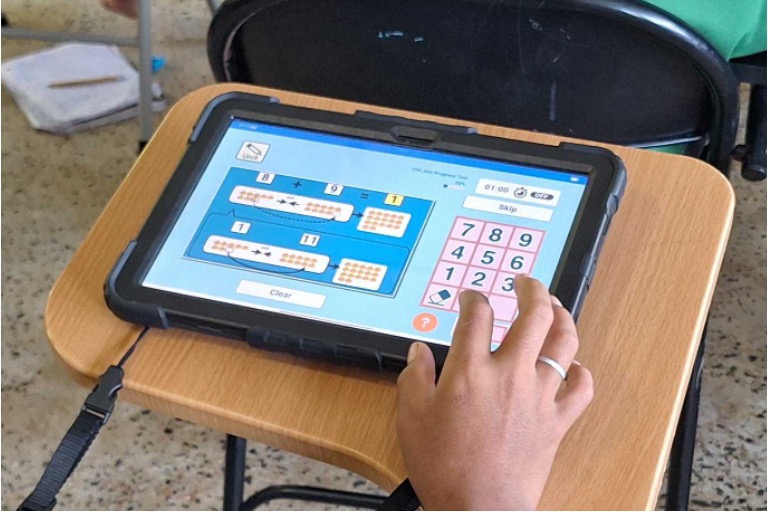
We developed “JICAL,” an original math application localized into local languages (English and Spanish), tackling these challenges through a technological approach.
- Step-by-Step Individualized Learning:
The app evaluates students’ answers in real-time. This allows children to accumulate successful experiences (“I solved it!”) at their own pace without needing constant teacher supervision, enabling autonomous learning. It functions as a powerful tool to supplement lessons even in the absence of a teacher. - Intuitive UI and Gamification:
We extensively use pictures and icons so that even early-grade students with low literacy rates can operate the app intuitively. By incorporating gamified elements like avatars and medal rewards, we built a learning environment that naturally makes children want to “solve more.” - Offline Capability and Low-Cost Operation:
The app is designed for offline environments, ensuring seamless use even in areas with unstable internet connectivity. No expensive equipment or specialized IT knowledge is required. We have established an operational ecosystem that can be implemented using affordable, locally procurable tablets.
Project Results and Feedback from the Field
Results from the JICA endline survey have demonstrated the app’s educational effectiveness. The group using the app showed a significant improvement in score growth rates compared to the group using paper drills. (Please refer to the links below)
- Background of App Development: “JICAL” Completion Report (Published October 2024) [PDF] (Japanese)
- Case Study: Application in Educational Settings in Papua New Guinea (May 2025) (Japanese)
- Results Report: Post-Implementation Track Record and Evaluation in Papua New Guinea (December 2025) (English)
Furthermore, the following non-score-related benefits have been reported from implementation sites:
- “There was a visible decrease in students relying on finger counting.”
- “The math app served as a motivator, leading to an overall improvement in school attendance rates.”
- “Because it can be operated regardless of pen pressure and allows students to work at their own pace, children in special needs classes can learn in the same way as those in regular classes.”
Future Directions: From Enhancing Educational Quality to Multi-Sector and Multi-Regional Expansion
Building on the success of this project, we are exploring the following multifaceted expansions:
- Multilingualization and Global Expansion:
A current challenge is that early-grade students often struggle to understand even their country’s official language. Therefore, in addition to English and Spanish, we need to support more local languages in developing countries. By removing the language barrier, we anticipate an improvement in foundational skills from the early grades. - Promoting Inclusive Education:
Learning with paper drills has been a significant hurdle for children with weak pen pressure or those requiring special assistance due to unique sensitivities. By leveraging the tablet’s advantage of “intuitive operation even with weak finger strength” and further refining the UI to accommodate children with diverse characteristics, we expect to create an environment where everyone can proactively engage in learning. - Visualization of Learning Data:
By analyzing accumulated learning data and providing a dashboard feature that allows teachers to see at a glance “which child is struggling with which module,” we can reduce the burden on teachers while realizing optimally personalized educational support. - Expansion of Usage Environments:
Currently, the app’s operating environment is limited to Android devices and PCs with internet connectivity. By expanding compatibility to iOS devices and offline PCs, we can further lower the hardware barriers to implementation. - Horizontal Expansion to Other Fields:
The “self-study digital learning model” and system expertise cultivated through this project can be laterally expanded to a wide range of areas, such as other academic subjects and vocational training.
-
Inquiry
- Thank you for visiting our website. Please send your inquiry after read and agree to our privacy policy. We will reply in the coming few days.
You can contact us without any charge.
Please feel free to contact us.