
Agriculture
(Projects)
18 June 2025
Challenges in Agriculture in Developing Countries

Due to climate change and underdeveloped infrastructure, farmers in developing countries face difficulties in predicting harvests and streamlining agricultural operations. They are required to farm by selecting crops and cultivation methods suited to the climate and soil characteristics, while also considering marketing and distribution. The challenge we faced in our field activities was not merely a “lack of technology,” but a “mismatch of information” between producers and sellers.
- Unpredictable Farming Risks:
There is a lack of information regarding the selection of crops and cultivation methods suited to climate and soil characteristics, forcing farmers to rely on experience and intuition, which hinders the optimization of farming operations. - Gap Between Supply and Demand:
Due to insufficient communication between buyers and sellers, production cannot be tailored to market needs, resulting in harvests not being traded at fair prices. - Information Opacity and Lack of Proposal Ability:
Because transaction prices and distribution volumes are not visualized, it is difficult for farmers to make better proposals to the market or ensure traceability (tracking production history).
Examples of IT Solutions
- Optimization of agricultural operations through weather forecasting and crop diagnosis apps utilizing satellite data and AI
- Provision of a mobile-based agricultural guidance platform
- Increasing transparency in agricultural supply chains and supporting transactions
Our Achievements
1. Project for Supporting Rice Industry Development in Tanzania: Database Construction (JICA)
Solution: Provision of an Agricultural Guidance Platform via Mobile App
To enhance the sustainability of rice cultivation training in priority rice production areas in Tanzania, we have begun providing a mobile-based agricultural guidance platform.
Project Results
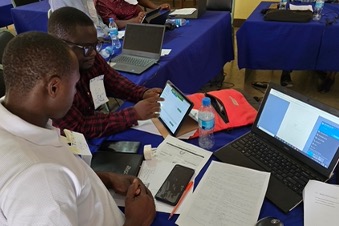
By solving local communication infrastructure and IT literacy challenges through technology, we established an “autonomous data operation foundation by the local government” that does not rely on Japanese experts, yielding the following results:
- Localization of Data Management:
We transitioned a massive amount of data, previously managed by Japanese experts using Excel and Access, into a system manageable by the local government. This established a foundation where relevant local institutions can immediately access the necessary data. - Improvement from Data Collection to Distribution of Analysis Results:
Data entered by extension workers on tablets is immediately sent to servers via the internet. By creating a system where relevant institutions can instantly review aggregated data, we streamlined the entire flow from on-site data collection to aggregation and the distribution of analysis results. - Establishment of Easy-to-Use UI/UX:
Despite being an advanced system equipped with aggregation and analysis functions, we designed a user-friendly UI/UX so that local staff can operate it intuitively without relying on manuals. - Offline Capability:
To ensure uninterrupted use even in farming areas with unstable communication infrastructure, we enabled operations in offline environments without internet connectivity.
Future Directions: Expansion to Multiple Regions
- Global Expansion:
Leveraging the successful model in Tanzania, we envision lateral expansion to neighboring countries.
2. Preparatory Survey for The Project for the Improvement of Horticultural Products Distribution at Notto Market, Senegal
Solution: Visualization of Market Information and Transaction Support
We utilize IT to visualize market information such as transaction prices and distribution volumes, thereby streamlining market operations, improving the distribution environment, and supporting transactions.
Project Results

We proposed a digital transformation (DX) that aims to increase transparency in the supply chain and enable smooth communication between buyers and sellers.
- Introduction of a Digital Information Sharing Foundation to the Market:
We aim to speed up information sharing by using digital signage to visualize market information that was previously shared solely through oral communication. - DX of Communication:
We are developing a “Buy and Sell” site that leverages the physical location of the market, creating an environment where buyers and sellers can easily communicate directly. - Enhancement of Security via Surveillance Cameras:
We improved security on the premises by installing surveillance cameras at various locations within the market. In addition to preventing troubles like theft, combining this with a public address system supports efficient market operations, such as monitoring congestion and smoothly guiding vehicles.
One Reply to “Agriculture”
Leave a Reply
Tag:
See more about Projects -
Inquiry
- Thank you for visiting our website. Please send your inquiry after read and agree to our privacy policy. We will reply in the coming few days.
You can contact us without any charge.
Please feel free to contact us.
気候変動とインフラ整備の遅れは、発展途上国の農家にどのような影響を与えていますか。